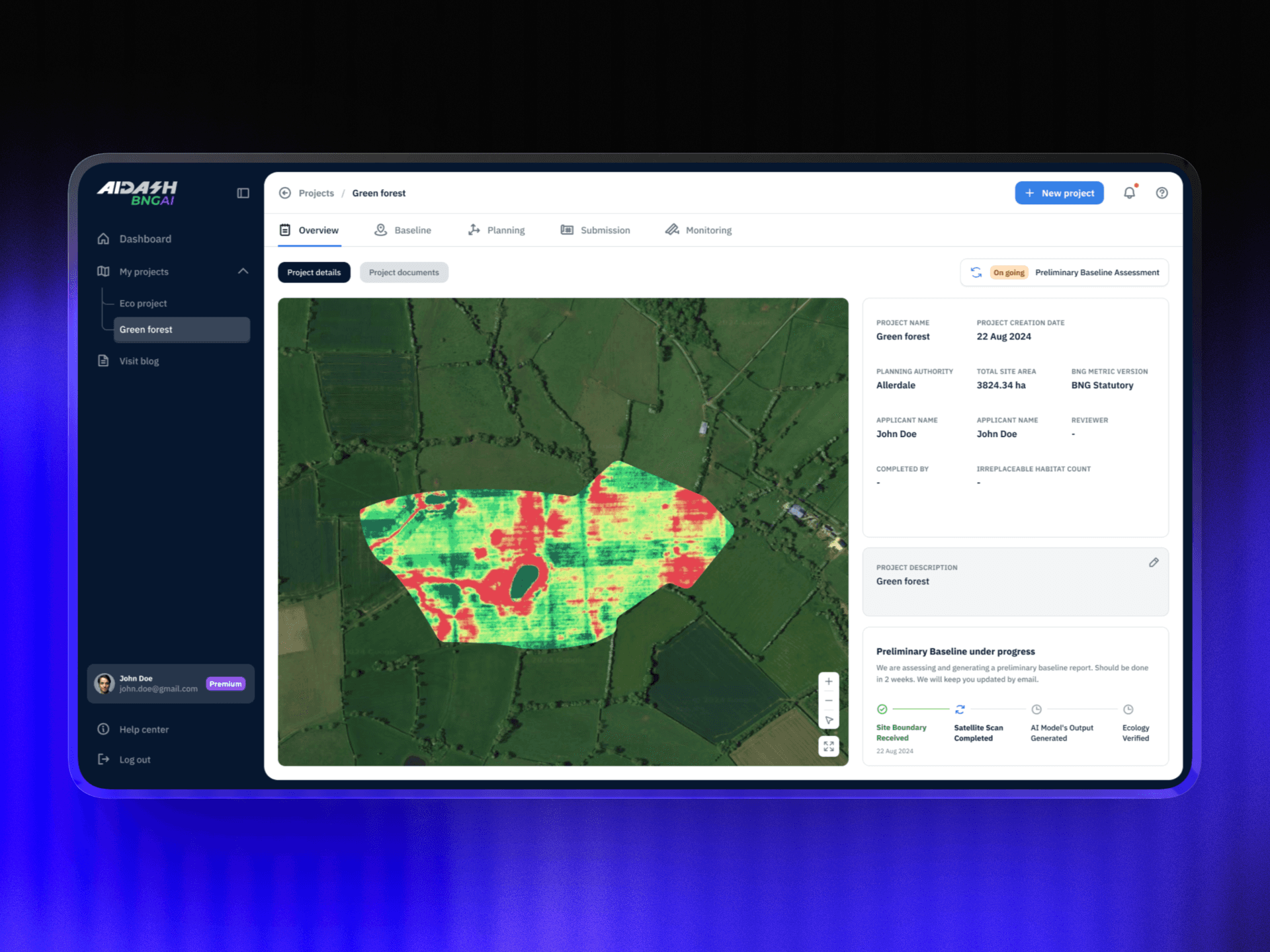
In 2024, the UK's Environment Act 2021 made biodiversity net gain (BNG) mandatory for new developments - a minimum 10% measurable improvement in habitat quality, not just offsetting. The industry can't deliver it at the pace the law demands: the UK is short by roughly 40% on qualified ecologists, and a traditional BNG assessment means sending surveyors on-site for weeks per project. That gap - between what regulation now requires and what the existing workforce can physically deliver — was the opening. It's the kind of bottleneck regulation itself creates, and exactly where satellite and AI tooling can close a real gap rather than just look modern.

We pitched into that gap: a platform replacing, or sharply shortening, manual habitat surveys with satellite-based habitat modeling, for developers, ecological consultants, and planning authorities who all have to move through the same compliance motions faster than the current process allows.
[image: Soil biodiversity in England]


Change in relative abundance of UK priority species, 1970 to 2016 Report by House of Commons Environmental Audit Committee
A web admin panel that walks a project through the actual compliance lifecycle instead of handing back one static report: Baseline → Planning → Submission → Monitoring, each stage traceable with its own status and sub-steps (Site Boundary Received, BNG Baseline Report, Post-development Scenarios, Post-development BNG Action Plan, Submission Ready Files).

The platform's central visual element is a smart map that turns raw land data into a color-coded biodiversity heatmap — making it immediately clear which zones of a site are healthy, degraded, or somewhere in between. It works from the ground up: the user submits a site boundary, a satellite scan covers that area, and an AI model translates the scan into a heatmap reflecting the site's actual ecological condition. Alongside the map, the app tracks how many habitats have been assessed and how their condition is distributed across the site.
A companion mobile app gives portfolio-level oversight — habitat units, area, hedgerow and watercourse data across every site a consultant manages, built for use in the field.

We didn't win the engagement - the pitch didn't convert into a signed client, and it's worth saying plainly rather than around it. It was also my first time designing this kind of data-dense admin product: staged status tracking and portfolio-level oversight across 16 separate sites, each with its own metrics, distinct from the checkout funnels and approval flows most of my prior work sat in.
What carried forward wasn't the AI-verification pattern - that one's shared with PayEm. It was something more structural: I'd just worked out how to take many separately-tracked things and compress them into one legible, color-coded view someone could scan in seconds instead of read as a report. That's exactly the problem SKAKO handed me next, at industrial scale instead of ecological - dozens of concrete mixers instead of habitat sites, silo levels instead of watercourse data, operators who needed to be walking the factory floor instead of chained to an office desktop. The color-coded, real-time mixer dashboard and the critical-level silo alerts I designed there are a direct continuation of the multi-entity status pattern this pitch forced me to work out first. SKAKO's version of it was later showcased at Bauma 2022, the world's largest construction trade fair, in front of 600,000+ visitors, as the company's flagship step into digital transformation.
What it says about how I work
The hard problem here wasn't visual - it was recognizing that a regulation-driven bottleneck is a design problem before it's an engineering one, and that dense, multi-entity operational data needs a status language before anyone can act on it fast. AiDASH didn't convert into a client. The pattern it forced me to solve - turning many chaotic, individually-tracked things into one legible live view - is one I now reach for by default, whether the things being tracked are habitat sites, concrete mixers, or invoices waiting on approval.